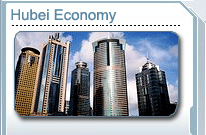
(China Daily) During the past four years, the city government of Wuhan, capital of Hubei Province, has made great efforts to promote the social and economic developments in the city.
Last year, the city achieved brilliant economic performance.
In 2006, Wuhan's output value reached 259 billion yuan, a growth of 14.8 percent from the previous year and a record high in the past 10 years.
Its fiscal revenue hit 50.24 billion yuan, increasing 256 percent from 2002, or growing 26.4 percent annually.
Fixed-asset investment was 132.53 billion yuan last year, up 232 percent from 2002, or increasing 22.1 percent annually.
Sales of consumer goods amounted to 129.3 billion yuan, representing an annual growth of 12.8 per cent in the past four years.
The past four years witnessed the fastest industrial growth in Wuhan since the country's reform and opening-up program began in the late 1970s.
Last year, the city's industrial enterprises realized an incremental output value of 88.05 billion yuan, increasing 235 percent from 2002 and growing 21.6 percent annually.
The number of the city's super-large enterprises, each with an annual output value of more 10 billion yuan, increased from one in 2002 to six in 2006.
Improved environment
With increased investment, the city's infrastructure and environment have been greatly improved.
During the past four years, the city has invested a total of 97.6 billion yuan to launch a number of infrastructural construction projects.
Capital poured into ecological improvement amounted to 5.72 billion yuan.
As a result, the city's forest coverage reached 21.88 percent, green land coverage hit 37.8 percent and its per capita green land area was 9.32 square meters.
In the central areas of the city, good air quality was reported in 75 percent of the days in the year of 2006.
Huge investment has also been channeled into the rural areas, resulting in substantial improvement of rural infrastructural facilities.
In the four years, 4,600 kilometers of highway have been built in the countryside. A total of 2,087 administrative villages have access to highways, TV broadcasting and telecommunication services.
In addition, broadband communication networks have reached 1,000 administrative villages.
The irrigation network has covered 85.5 percent of the rural areas and 56.5 percent of the administrative villages have access to tapped water supply.
As a result of the exemption of agricultural tax and related charges, 152 administrative villages have been relieved from poverty.
The pace of attracting foreign investment has been accelerated.
During the four years, accumulative foreign direct investment in Wuhan amounted to $7.02 billion, representing an annual growth of 14.5 percent.
A total of 67 Fortune 500 companies have investment projects in Wuhan in 2006, compared with 41 companies in 2002.
Last year, the city's foreign trade volume amounted $8 billion, growing 3.6 times from 2002. Export value was $3.7 billion, up 3.4 times.
During the past four years, the city has invested 35 billion yuan in public facility construction, with annual growth rate of 24.6 percent.
As a result, people's living standard has been greatly improved.
In 2006, the per capita disposable income of Wuhan's urban residents was 12,360 yuan, growing 58.1 percent from 2006. The per capita net income of rural residents amounted to 4,748 yuan, up 44.1 percent from 2002.
Behind the impressive progress are the efforts made by the city government.
Sticking to the principles of "innovation, human-orientation, pragmatism and integrity," the city government has probed a new way of growth with Wuhan's characteristics to promote the sustainable social and economic development.
Innovation and reforms
One of the efforts the government has made is the arrangement to help the city's industries optimize industrial structure and improve competitive strength.
The government has given priority to the development of five industrial clusters and 10 pillar industries.
Emphasis has been given to such sectors as the high-tech industries, modern manufacturing industry, modern service industry and modern agriculture.
The high-tech industry is an important engine for the city's economic growth. In 2006, the city's high-tech industry realized an output value of 110 billion yuan, growing by 19.8 percent year-on-year.
Relying on its strength in the optical industry, the Wuhan city government has proposed to build a "Chinese Optical Valley" in the city. A number of optical enterprises, with the optical fiber giant FiberHome as the leader, has made brilliant performance in both domestic and overseas markets.
The modern service industry focuses on the development of logistics, exhibition and convention and intermediary service.
While deepening the reform of State-owned enterprises (SOEs), the city government has also attached equal importance to the development of private economy.
Last year, the numbers of private enterprises and household firms were respectively 2.3 times and 2.4 time the figures in 2002.
In the past four years, the city government has offered financial assistance worth 7.13 billion yuan for SOE reform, helping relocate 339,000 laid-off workers from the SOEs.
Human orientation
How to improve the living standard of the people has always been a priority on the city government's work agenda.
During the past four years, the city has created more employment opportunities, helping 323,700 laid-off workers and 186,300 rural laborers find jobs in the city.
The government has expanded the coverage of the social security system for the urban and rural residents.
In 2006, 1.83 million, 1.96 million, 912,000, 510,000 and 50,000 urban residents have been covered by the pension, medical insurance, unemployment insurance, injury insurance and birth insurance systems respectively.
The social security system has also been promoted in the rural areas.
Wuhan is the first city in Hubei Province to establish a minimal living standard guarantee system for the rural residents.
Last year, 86 percent of the rural residents have been covered by the cooperative medical insurance system.
The city government has also established an assistance mechanism for the disabled people and people with difficulties in housing, schooling and employment.
To realize an all-round social progress, the city invested 7.47 billion yuan in the past four years in the undertakings of science, education, culture, healthcare and sports.
Government of integrity
The city government has been devoted to building a government of integrity and pragmatism, aiming at offering efficient, transparent and high-quality services for the public and businesses as well.
According to the requirement of the central government and based on the concrete conditions of the city, the government has strengthened marco-economic control.
Some fixed-asset investment projects are the target of the macro-control. Twenty-six projects, involving a total investment of 4.04 billion yuan, were ordered to shut down, because they do not conform with State's related policies or cause pollution to the environment.
To protect the farmland, the city government has cancelled the operation and development of 49 development zones and parks, saving a total of 3,343 hectares of farmland.
According to the principle of "rule of law," the city government terminated or revised 1,321 administration regulations and laws, further streamlining the administrative approval procedures.
To improve administrative efficiency, the city government and its subsidiary governments have established administrative services centers, offering one-stop services for the public and businesses.
Stricter management on fiscal revenues and expenditure is an important part for building a government of integrity.
The city government tightened control on government purchase, budget planning, land leasing, public facility construction and State-owned assets transaction.
Growth targets
The city government expects further social and economic progress in the next five years.
The growth targets for 2007 are as the following:
The output value is expected to grow by 12.5 percent year-on-year, fiscal revenues increase by 14 percent, energy consumption for per 10,000 yuan of output value decrease by 3-4 percent, discharge of pollutants be reduced by 2 percent, social fixed-asset investment grow by 18 percent, sales of consumer goods increase by 13 percent, per capita disposable income of urban residents increase by 10 percent, per capita net income of rural residents grow by 9 percent, and unemployment rate in urban areas decrease by 4.5 percent.
The city government further predicts the city's annual output value will reach 470 billion yuan, increasing 12 percent annually, within five years. The fiscal revenue is expected to hit 100 billion yuan, growing by 14.9 percent annually. And the energy consumption for per 10,000 yuan of output value will decrease by 20 percent in five years.
The ecological environment will be further improved.
The green land coverage will surpass 40 percent, with per capita green land area in the city proper reaching 12 square meters.
More than 80 percent of urban sewage will be treated and the quality of more than 60 percent of the river and lake waters will meet the national standards. In addition, discharge of pollutants will be reduced by 10 per cent within five years.
Further progress will be made in such social undertakings as science, education, culture, healthcare and sports. Senior middle school education will be popularized in all the areas in Wuhan and people's life expectancy is expected to surpass 78 years.
Legal construction and democracy will be enhanced, ensuring that people's interests will be well protected.
People's living standard will be further improved. The annual per capita disposable income of urban residents is expected to reach 20,000 yuan in five years, growing by more than 10 percent annually. The per capita net income of rural residents is projected to hit 7,600 yuan, increasing by about 10 percent annually. And 95 percent of the urban residents will be covered by the pension system and 80 percent covered by the medical insurance system. The unemployment rate is expected to be lower than 5 percent.
Further efforts
To fulfil the targets, the city government will make further efforts to promote industrial structural adjustment, enhance investment in infrastructural construction and attract foreign investment.
It will help increase the ratio of modern manufacturing and service industries in the city's overall economic composition.
It is planning to build Wuhan into a modern manufacturing base in Central China, with the sector's incremental output value in 2011 growing more than 100 percent from 2006.
In 2011, the incremental value of the service industry is expected to reach 240 billion yuan.
It also hopes to make Wuhan an important high-tech innovation base in China, with the number of national key laboratories reaching 20 and the number of national key technology research centers hitting 20.
The government expects more investment to be channelled into the construction of transportation, logistics and information facilities.
In addition, while expecting the growth of the State-owned economy, the city government will offer more preferential treatment for the development of private and foreign-invested enterprises.
It is predicted that the city's total foreign investment will amount to $10 billion and export volume will reach $200 billion in 2011.